



Why Unit Entitlement Valuations Matter in Strata Schemes
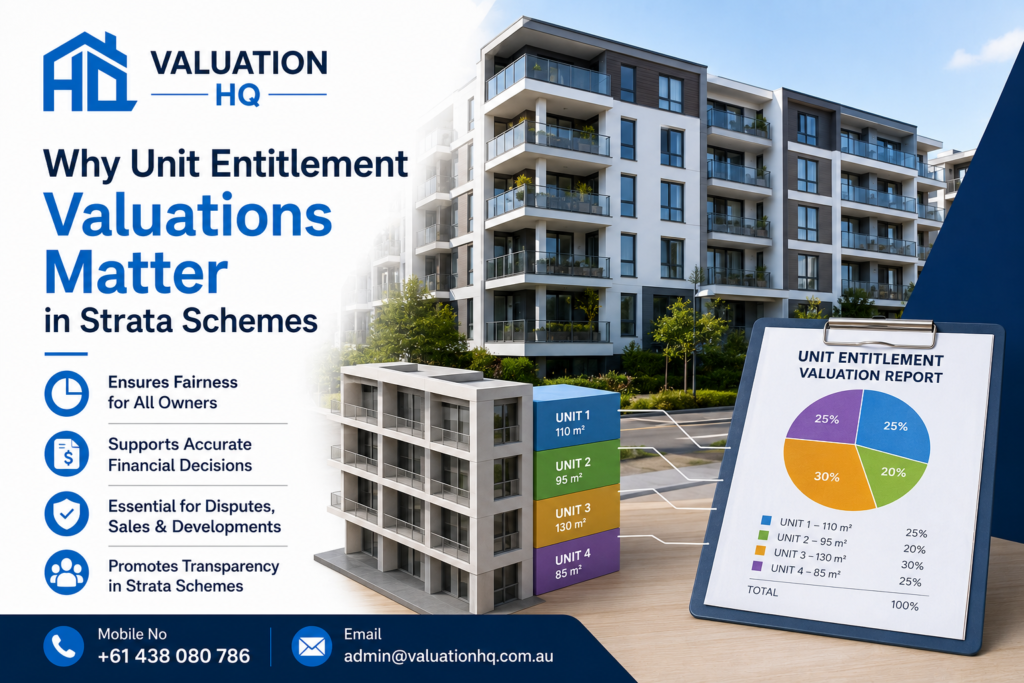
Every strata scheme divides financial obligations and certain voting rights among owners according to a figure many people rarely consider until a dispute arises: their unit entitlement. This figure can influence how much each owner contributes toward levies, how voting is calculated for particular decisions, and how proceeds may be distributed if the scheme is sold as a whole. When unit entitlements no longer reflect the relative value of each lot because of additions, changes to permitted use, or an unreasonable original assessment, some owners may contribute an unfair share of common expenses for years without realising it.
This guide explains what a unit entitlement valuation involves, why an accurate assessment is important for fairness within a strata scheme, and when owners or an owners’ corporation should consider having existing entitlements independently reviewed.
SUMMARY
What This Article Covers: This guide explains what unit entitlements are and how they are calculated within a strata scheme. It covers why accurate entitlements matter for levy contributions and voting rights, the situations that commonly call for a reassessment, and how an independent valuer approaches this specialised type of assessment. It also answers the questions owners and owner corporations ask most often about unit entitlement valuation.
What Unit Entitlements Actually Determine
Unit entitlements are the figures assigned to each lot within a strata scheme that determine an owner’s share of the scheme’s financial and governance matters. These entitlements dictate how much each owner pays toward administrative and capital works levies, how much voting weight their vote carries at general meetings on matters decided by unit entitlement rather than a simple show of hands, and how proceeds would be distributed among owners if the entire scheme were ever collectively sold.
Because these entitlements affect owners financially every single year through ongoing levy contributions, an inaccurate assessment does not simply create a one-off inconvenience, it can mean certain owners are effectively subsidising others for as long as the entitlements remain unchanged. This is precisely why getting the underlying valuation right matters so much, both at the time a scheme is first registered and whenever circumstances materially change afterward.
How Unit Entitlements Are Calculated
Unit entitlements are generally based on the relative market value of each lot at the time the strata scheme is registered, reflecting the principle that owners with more valuable lots should bear a proportionally larger share of the scheme’s collective costs.
The Relative Value Method
Most Australian jurisdictions require unit entitlements to be assessed using a relative value method, meaning a qualified valuer assesses the value of each lot relative to every other lot within the scheme at the time of registration, rather than assigning entitlements based purely on floor area or an arbitrary formula.
Why Floor Area Alone Is Not Always a Fair Basis
A simple floor area-based approach can produce an unfair outcome where lots of similar size carry meaningfully different values due to factors such as views, aspect, or floor level, which is why most strata legislation favours a genuine relative value assessment over a purely mathematical floor area calculation.
When Unit Entitlements Should Be Reassessed
Several circumstances can cause unit entitlements originally assigned at registration to no longer reflect the genuine relative value of lots within a scheme.
Renovations and Lot Improvements
Where individual owners have significantly renovated or improved their lots since the scheme was registered, the relative value relationship between lots can shift, potentially making original entitlements outdated even though they remain technically unchanged.
Additions or Changes to Common Property
Where common property has been added to or substantially altered, such as through the addition of new facilities, this can affect the relative value distribution across lots and warrant a fresh look at whether entitlements still reflect a fair distribution.
Disputes Between Owners
Where owners genuinely believe their unit entitlements do not reflect their lot’s fair relative value compared with others in the scheme, an independent valuation provides the evidence needed to support an application to vary entitlements through the appropriate legal process.
How an Independent Valuer Approaches Unit Entitlement Assessment
Assessing unit entitlements requires a valuer to consider each lot’s value in relation to every other lot within the scheme, rather than simply valuing each lot in isolation.
Assessing Each Lot’s Relative Value
The valuer considers factors such as floor area, aspect, floor level, outlook, and access to any exclusive use areas for each lot, comparing these characteristics across the entire scheme to arrive at a fair relative value for every unit.
Providing Evidence for Legal Applications
Where owners seek to formally vary unit entitlements through an application to the relevant tribunal or court, an independent valuation report provides the evidentiary basis required to support that application with genuine, defensible reasoning.
The Legal Framework Behind Unit Entitlements
Unit entitlement assessment does not happen in a vacuum but instead follows a specific legal framework set out in strata legislation across each Australian jurisdiction.
State-Based Strata Legislation
Each state and territory has its own allocation rules; Queensland uses separate contribution and interest schedules, with different statutory principles governing each schedule.
The Role of the Registered Strata Plan
Unit entitlements are formally recorded on the scheme’s registered strata plan at the time of registration, and any subsequent variation generally requires a formal legal process rather than simply an agreement between owners to informally adjust the figures.
Why Accurate Unit Entitlements Matter for Every Owner
Beyond the immediate financial impact of levy contributions, accurate unit entitlements support genuine fairness in how a strata scheme is governed and how major decisions are made.
Voting rights on significant matters, such as approving substantial capital works or making decisions about the scheme’s future, are often weighted according to unit entitlement, meaning inaccurate entitlements can distort not just financial contributions but also the balance of influence different owners hold over decisions affecting the entire scheme.
When to Consider a Unit Entitlement Valuation
● When a strata scheme is first being registered and entitlements need to be established
● When significant renovations have changed the relative value of individual lots
● When common property has been substantially added to or altered
● When an owner believes their entitlement does not reflect their lot’s fair relative value
● When an owners corporation is considering an application to vary entitlements
● When disputes over levy contributions or voting weight arise between owners
Frequently Asked Questions
Q: What are unit entitlements in a strata scheme?
A: They are figures assigned to each lot that determine an owner’s share of levies, voting weight, and distribution of proceeds if the scheme is collectively sold.
Q: How are unit entitlements calculated?
A: Most Australian jurisdictions require a relative value method, where a qualified valuer assesses each lot’s value relative to every other lot within the scheme.
Q: Can unit entitlements be changed after a scheme is registered?
A: Yes, through a formal application to the relevant tribunal or court, supported by an independent valuation demonstrating the current entitlements no longer reflect fair relative value.
Q: Do renovations affect unit entitlements?
A: They can. Significant renovations to individual lots can shift the relative value relationship between units, potentially making original entitlements outdated.
Q: Why not just use floor area to set entitlements?
A: Floor area alone can produce unfair outcomes where similarly sized lots carry different values due to views, aspect, or floor level, which is why relative value assessment is generally required instead.
Q: Do unit entitlements affect voting rights?
A: Yes. Many significant strata decisions are weighted according to unit entitlement, meaning inaccurate entitlements can distort both financial contributions and voting influence.
Q: Who should prepare a unit entitlement valuation?
A: A qualified, independent valuer experienced in strata schemes and relative value assessment should prepare the report, particularly where it may support a formal legal application.
CONCLUSION
Unit entitlements determine far more than a simple percentage on a strata roll, shaping how much each owner contributes toward shared levies and how much influence they hold over decisions affecting the entire scheme. Ensuring these entitlements genuinely reflect the relative value of each lot protects fairness for every owner within a strata scheme, both now and as circumstances change over time.
Engaging an independent valuer experienced in unit entitlement assessment gives owners and owner corporations confidence that levies and voting rights are being distributed fairly across the scheme.
Need a Unit Entitlement Valuation? Contact Valuation HQ
Valuation HQ prepares independent unit entitlement valuations for strata schemes, owners corporations, and individual owners across Australia, supporting both initial registration and formal applications to vary existing entitlements.
Visit valuationhq.com.au | Australia Wide